Foundation models improve every quarter and get cheaper. For anyone building a vertical AI application in legal, accounting, financial services, or consulting, that poses a question: as model capability rises, what durable moats can a vertical company build to compete?
Jay Mandal and I wrote a paper on it, published this week by Stanford Law’s CodeX (the Stanford Center for Legal Informatics): “Defensible Moats for Vertical AI Application Companies in a New Competitive Landscape.”
The competitive landscape is shifting rapidly
Vertical software was dominated by SaaS companies for two decades. Foundation models added a new set of competitors at once: AI-native startups, AI-enabled SaaS businesses, AI-native and AI-enabled services firms, open-source applications, and in some cases the model providers.
In Legal the competitive landscape has broadened. Incumbents (Thomson Reuters, LexisNexis, Wolters Kluwer) still hold exclusive access to primary law and regulatory content and are adding AI products on top. AI-native startups (Harvey, Legora, Eudia) have gained distribution quickly and are carving out the market. Law firms are also building their own applications and open-source projects are replicating the leaders cheaply. Finally the model providers have also to an extent entered the market with Anthropic’s Claude for Legal and OpenAI’s announced legal vertical, and their recently announced partnerships with system integrators. The same shift is starting across accounting, financial services, banking, healthcare, and life sciences.
Five product moats for competing at this layer
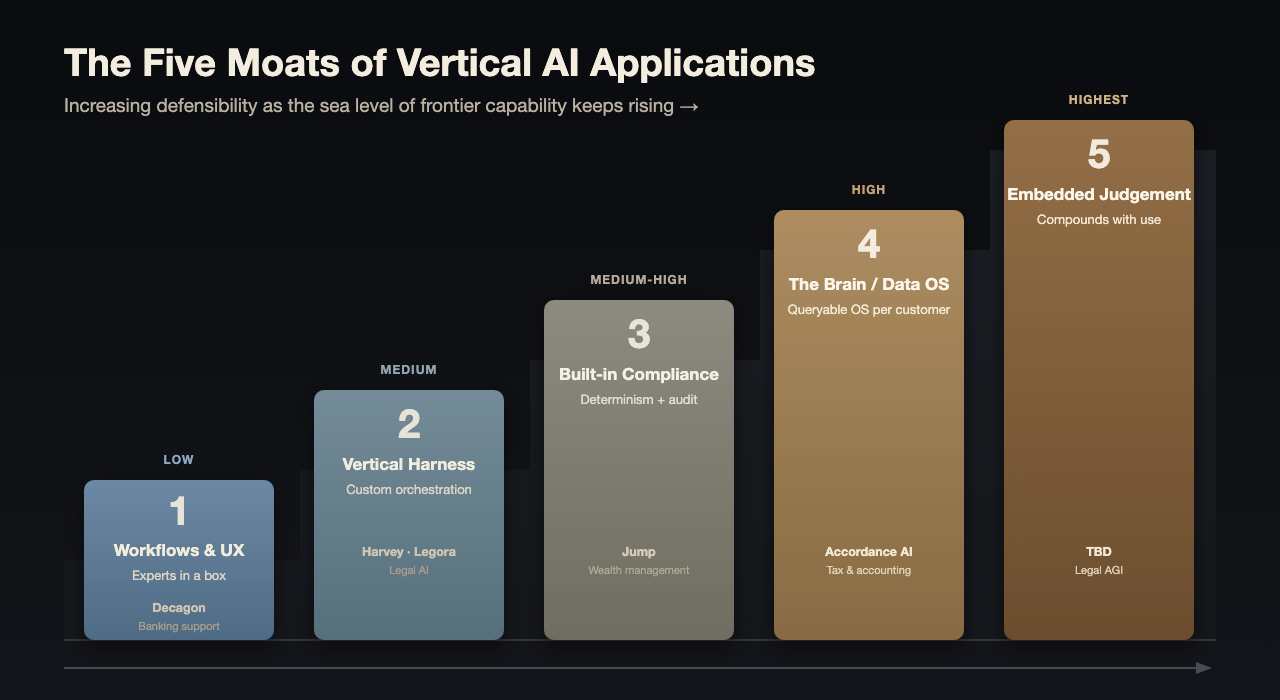
We rank five product moats in ascending order of strength. The weaker ones are easier for a competitor to replicate.
-
Workflows and UX. Encode a customer’s operating procedures as skills, an expert-in-a-box. This has value, but a competitor can build the same, so it is the lowest moat. Decagon does this for banking customer service, with agents that field more than one million calls a month for Chime.
-
The vertical harness and custom tools. Build the tools and integrate the in-house and legacy systems horizontal players will not touch, then orchestrate tools, context, memory, and security around one industry. Harvey and Legora compete on legal-native integrations: iManage, document management, and research connections. The underlying model is interchangeable.
-
Built-in compliance. Meet regulatory and policy requirements with the determinism, explainability, and auditability that raw models lack, and keep the UX clean. Jump does this for wealth management and commands a price premium over horizontal recording tools. It reached roughly 27,000 advisors in under two years.
-
The Brain, a data-driven operating system. Encapsulate hard-to-obtain proprietary data into a vertical-specific system: curated public authority, private client context, real-time data, and physical data, plus operating insights from the combination. Accordance built this for tax and accounting on a curated corpus of statutes, standards, and precedents fused with each firm’s own context. Switching costs rise the longer the system runs.
-
Embedded judgment. Encode the judgment and taste of expert practitioners as business logic that guides decisions at key points in complex workflows. The system learns from the decisions the best practitioners make, and the gap widens with every customer. This is the hardest moat to codify and the most exposed to model progress.
Three operational moats (distribution, engineering, and operational excellence) strengthen the product moats but do not stand on their own.
The takeaway
As model capability rises, the value of any single workflow, tool, or product shipped alone falls. The durable value is the system: a combination of the five product moats, strengthened by the operational moats.
The paper has the full framework, the company case studies, and open questions on how the hierarchy shifts as models grow more autonomous.
Read the paper: https://law.stanford.edu/publications/defensible-moats-for-vertical-ai-application-companies-in-a-new-competitive-landscape/
Stanford CodeX shared on LinkedIn: https://www.linkedin.com/feed/update/urn:li:activity:7473473710163795969/
Related Articles
Inside the State of AI Transformation: Insights from 100+ Top Tech Executives
Anna Jacobson, Partner and Chief AI Enablement Officer at Operator Collective, walks through a survey of 123 senior operators implementing AI. About 70% have no formal way to measure AI's impact, AI-native companies push accountability down to every employee, and executives adopt chatbots at the same rate as their companies while using specialized tools far less.
Read articleWho Owns the Legal AI Harness?
Baker McKenzie & Legora on Build vs. Buy, Pricing, and the future of Legal AI
Read article