Brand storytelling, creative visual merchandising, and emotional triggers have been the basis of e-commerce targeting humans. But Agents don’t respond to these. AI without eyes, emotions, or patience for advertisements requires different inputs.
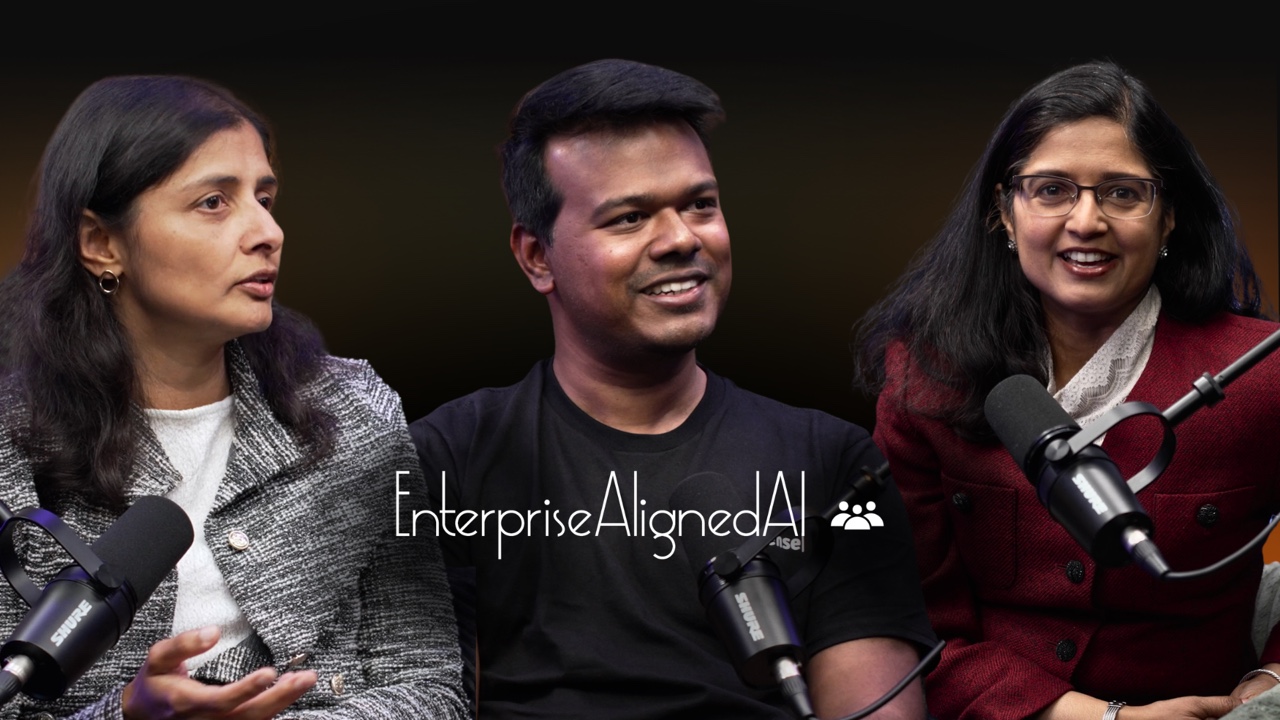
In this episode of Enterprise Aligned AI, I sat down with Deepa Shekhar, Director of E-Commerce Technologies at Logitech, and Jason Bosco, CEO and Co-Founder of Typesense, to map out the technical, semantic, and structural plumbing required for Agentic Commerce.
Logitech recently won a prestigious accolade in Semrush’s 2025 AI Visibility Awards for Consumer Electronics, as a highly discoverable and trusted brand in the AI ecosystem. The secret to their win was a radically new content strategy, and their investment in a low latency, high accuracy enterprise data architecture. This is the operational blueprint of how Logitech.com transformed to optimize share of voice in AI, enabled by the underlying search infrastructure from Typesense.
Semrush AI Visibility Award: Navigating the Great Content Shift
To win users inside LLM answer windows, Deepa explains that marketing and technology teams must partner closely, and jettison the keyword-based SEO mindset. When a consumer shifts their shopping journey to platforms like ChatGPT, Perplexity, or Gemini, they are no longer browsing catalogs; they are asking highly contextual, intent-driven questions about problems they want to solve. Deepa notes the queries that are winning Logitech AI market share today:
“What is a good mouse for long working hours?”
“What is a good mouse that works cleanly on a glass surface?”
Logitech brought together marketers from various business units, channels, and the core brand team and fully updated their content strategy. By optimizing content for machine readability and semantic relevance, Logitech ensured their products surfaced as the top trusted answers. Here’s their playbook:
- Write Semantic Content: Marketers stopped writing copy about abstract product features and began authoring content to answer problems customers were trying to solve.
- Engineer Agent Readability: The technology team took this problem-solving content and published it in highly structured formats that LLMs can digest quickly. They deployed modern AI-readability standards like llms.txt, which acts as an explicit AI sitemap instructing LLMs on the navigation paths to find authoritative brand data.
💡 Actionable Advice for Leaders: Update your marketing content to mirror customer questions. Audit top-performing pages and anchor text around contextual customer problems that semantic search algorithms look for.
The Three Tracks of Agentic Commerce
“I see agentic commerce evolving across three tracks, distinguished by where the commerce transaction takes place and who owns the consumer experience… We must execute on all three tracks to be successful.” — Deepa Shekhar
- Track 1: LLM Platforms as Strategic Engines of Commerce. Discovery and transaction journeys are moving from retailer websites to third-party LLMs like ChatGPT and Gemini. The new KPIs are visibility and conversion inside LLM platforms, not website click-through rates.
- Track 2: Proprietary Brand Agents Grounded in Your Data. Building your own AI Agents (in your app, your website, messaging channels etc.) is more important than ever in your unique brand voice enriched with your user and product data.
- Track 3: Pure Algorithmic Buying. Soon, personal consumer AI agents will shop on behalf of humans, and enterprise systems need to be ready. Agents rely on structured data and select products objectively based on operational parameters, e.g., granular specifications, shipping velocity, and historical fulfillment reliability.
Preparing Data for Agentic Commerce
All three tracks require data preparation, integration and LLM optimized search. Commerce data is typically fragmented across separate backends including pricing engines, real-time inventory systems, content databases, and Product Information Management (PIM) software. Instead of forcing an Agent to query multiple backends in real time, which causes extreme latency and wastes tokens, enterprises must assemble this multi-source data into a single, unified database layer, indexed by a specialized, low latency search engine.
Deepa recommends an architecture that uses a high-performance search engine like Typesense as the semantic layer and central orchestration hub. In this architecture, the Agent LLM does intent detection: it parses natural language variations, captures customer synonyms, and maps user context (like translating a query about a “repetitive strain injury” into an ergonomic design match). Intent is then passed to a search engine like Typesense allowing the Agent LLM to run more complex queries in a shorter timeframe, resulting in better answers, and higher AI visibility. Typesense can run dozens of query combinations across millions of records in milliseconds. It takes the fragmented, slow data from your core systems, indexes it, and exposes it as a blazing-fast, high-availability API.
💡 Actionable Advice for Leaders: Create a fast semantic search layer and use LLMs to augment your data. Decouple extraction from storage. Use LLMs offline to auto-tag product catalogs with synonyms, and real-world context so the underlying data store is pre-optimized for semantic queries.
Agents Already Make Product Decisions
Perhaps the best moment of the discussion was Jason’s recent Agentic Commerce encounter.
After this, Jason updated Typesense’s technical assets to ensure full machine-readability; so that documentation is served as markdown alongside HTML. Typesense also now embeds metadata instructions in their pages pointing to markdown versions of each page, ensuring agents don’t waste tokens parsing decorative web formatting.
💡 Actionable Advice for Leaders: Create markdown-native layouts for your documentation and assets. AI crawlers and buying agents prefer markdown over complex HTML.
Product Catalog Integration
One roadblock facing enterprises trying to plug into Agentic Commerce is the lack of a unified mechanism to share product catalogs with LLMs. Deepa summarizes the fragmented mosaic of evolving, incomplete protocols engineering teams face:
- SEO and Structured Feeds: traditional semantic tagging and canonical metadata feeds remain essential. However, the penalty for data discrepancies is now severe. If your feed frequency falls behind, AI (e.g., ACP) will penalize your visibility. Feeds must now be refreshed in minutes rather than hours.
- OpenAI’s Agentic Commerce Protocol (ACP): provides structured capabilities for syncing catalogs, pricing models, and active promotions. It lacks native payment capabilities, requiring a secondary marketplace model or merchant-of-record partnerships with Stripe. ACP uses inventory data for discovery ranking, making a fast backend more important for AI visibility.
- Universal Commerce Protocol (UCP): defines standards for checkout, order updates, and payment handoffs. As buying agents execute these transactions asynchronously, inventory validation often happens in a single flash-point at checkout. To survive this without systemic cart abandonment, merchants must construct high-availability, low-latency APIs running in parallel to feed real-time inventory counts during protocol handoff.
- Model Context Protocol (MCP): While highly anticipated, MCP is not yet intuitive for scaled retail. It functions more like a sandboxed app extension inside the LLM container (similar to custom apps within ChatGPT) rather than a dynamic, automated communication framework.
The industry needs a unified, cross-platform protocol that seamlessly binds real-time inventory, batch product attributes, and multi-vendor financial transactions into a single standard.
Modernizing Legacy Backends
An interesting barrier to scalable agentic commerce is that traditional enterprise backends (ERP, WMS, and OMS systems) are architected for batch processing, syncing data overnight or in hours-long intervals rather than milliseconds. They assume human web traffic, which naturally throttles itself, and are structurally unequipped to handle high-frequency, low-latency read/write loops from automated software.
Emerging unified frameworks like the Order Exchange Protocol (OnX), championed by a consortium of modern OMS and e-commerce vendors, are aiming to solve this by introducing standardized, real-time eventing layers. Startups that successfully build real-time, ultra-low-latency translation layers over legacy, batch-processed systems will unlock an immense enterprise market opportunity.
Lastly, we barely scratched the surface on how to manage financial risk in Agentic Commerce, noting the significant developments still to come in this area.
Bottom Line
Agentic commerce requires significant re-architecture across functions. The brands that win the next decade will build their data, their content, and their infrastructure for machines and humans. Logitech is showing that work is already paying off in measurable share of voice; Typesense is showing the stack underneath has to be rebuilt for agents querying in milliseconds, not humans browsing in seconds.
📖 Full episode with timestamps, key takeaways, and show notes.