A conversation with Anna Jacobson, Partner and Chief AI Enablement Officer at Operator Collective. Interview date: May 8, 2026.
Who participated in the survey?
Aparna Sinha: The Operator Collective is a unique, high-powered group of top CXOs from iconic companies. You recently conducted a State of AI survey across your executive members.
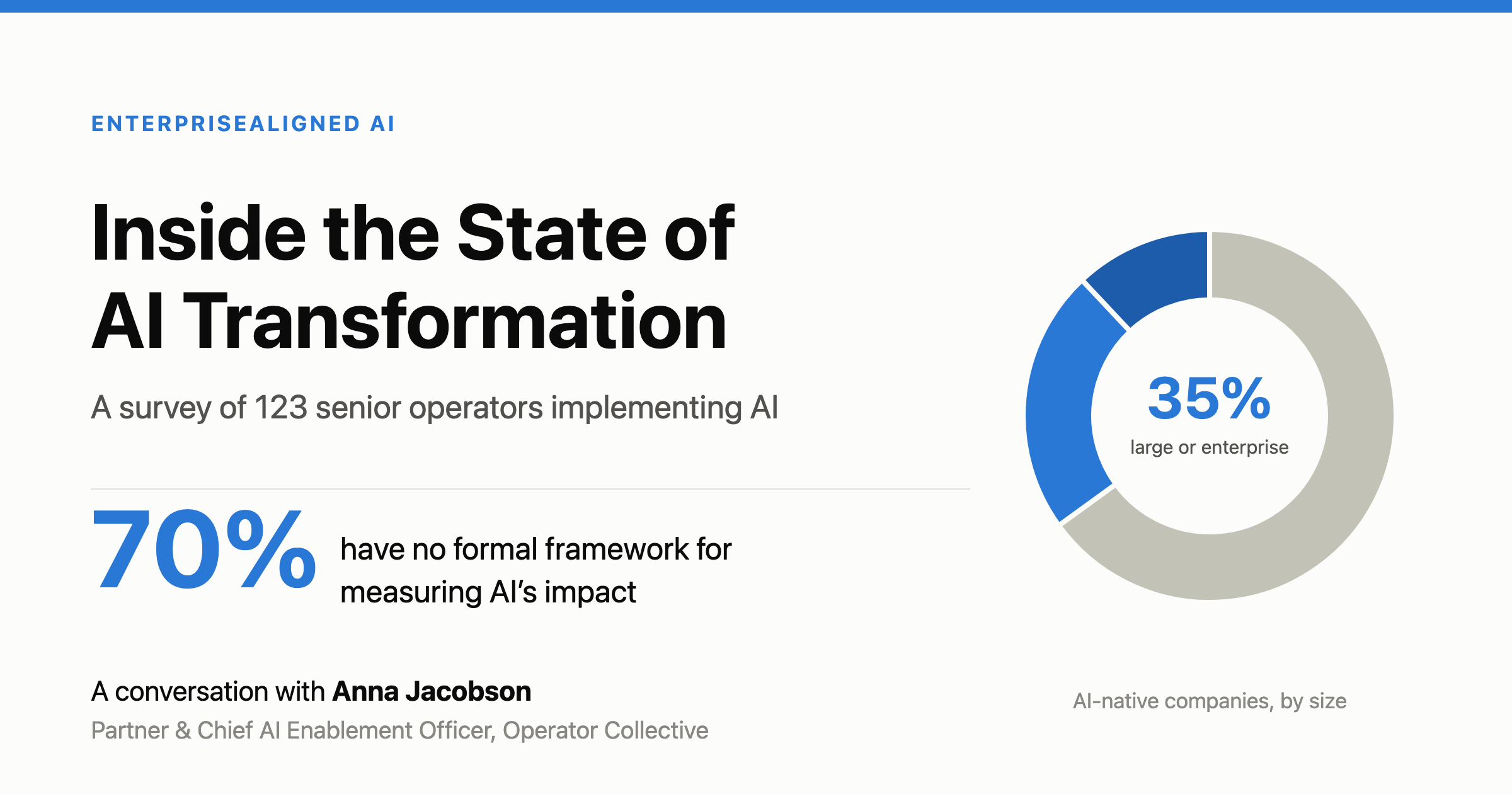
Anna Jacobson: The State of AI Transformation 2026 report was published in February 2026, with data gathered from November through January. We surveyed 123 operators, including our Operator LPs and portfolio company founders, ranging from agile AI-native startups to tech giants like Anthropic, OpenAI, Stripe, and Circle.
Regarding company scale, 18% of respondents represented enterprise organizations (5,000+ employees), 32% were from large companies (1,000 to 5,000 employees), and the remaining 50% were small-to-medium businesses. This gave us a clean 50/50 split between enterprise and large versus small and medium organisations.
One striking pattern stood out immediately: the smallest companies were often the most mature in their AI journey. Because they were founded recently, they built their entire architecture around AI from day one. In short, AI maturity was usually an inverse correlate of company size.
AI-native is possible at any size
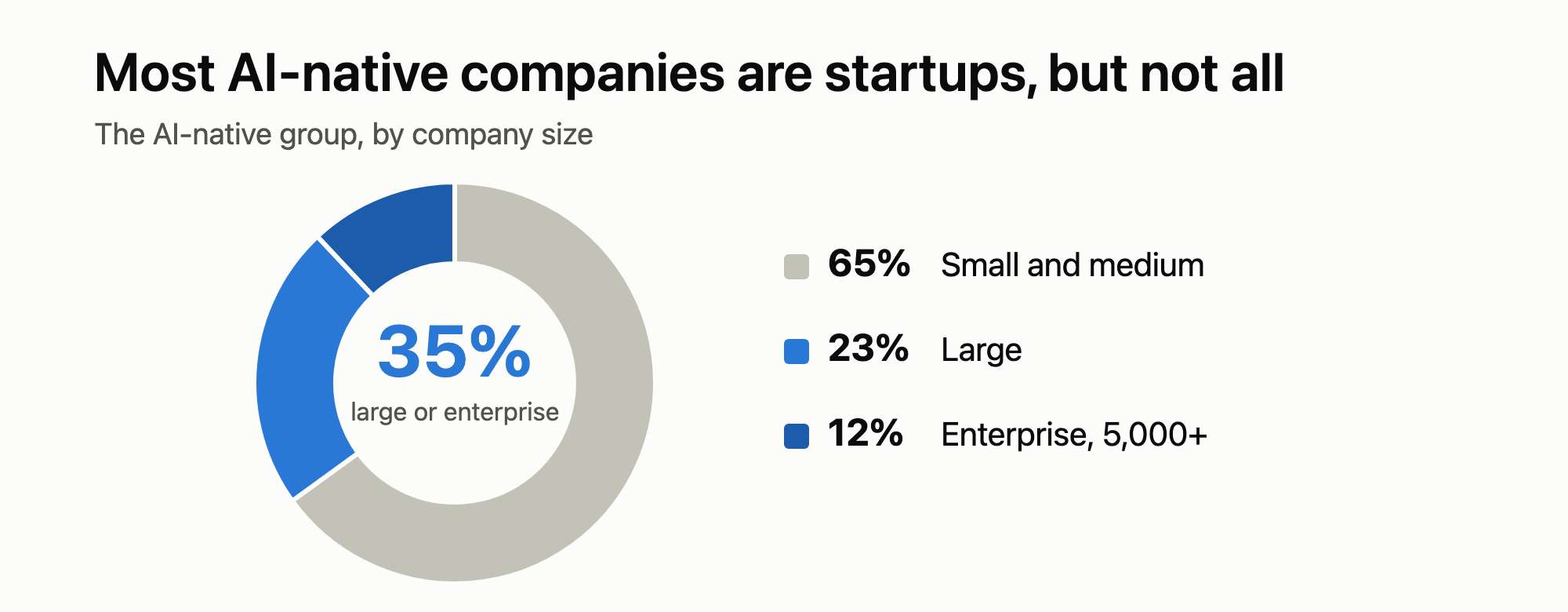
Anna Jacobson: About 21% of respondents self-identified as AI-native, meaning AI drives continuous innovation and is central to their business model. I expected this group to consist entirely of our portfolio startups, but it was surprisingly balanced across company sizes: 65% were small or medium, 23% were large, and 12% were enterprise. The median operating experience among AI-native leaders was 21 years, nearly identical to the overall survey average of 22 years.
Two key traits set AI-native organizations apart:
- Bottom-up accountability. 50% state that every employee is directly accountable for AI transformation, while another 19% operate with no formal assignment.
- Deep AI fluency. 77% of AI-native leaders rated themselves as advanced or expert in AI, compared to 38% overall, and they were 50% more likely to adapt their talent profiles accordingly.
Who leads AI transformation at AI-native companies?
Anna Jacobson: Large and enterprise companies strongly favor a top-down model: 28% assign ownership to a designated C-level executive, and 27% rely on a steering committee or working group. Conversely, small and medium companies lean flexible, with 24% empowering all employees directly and 37% having no formal assignment.
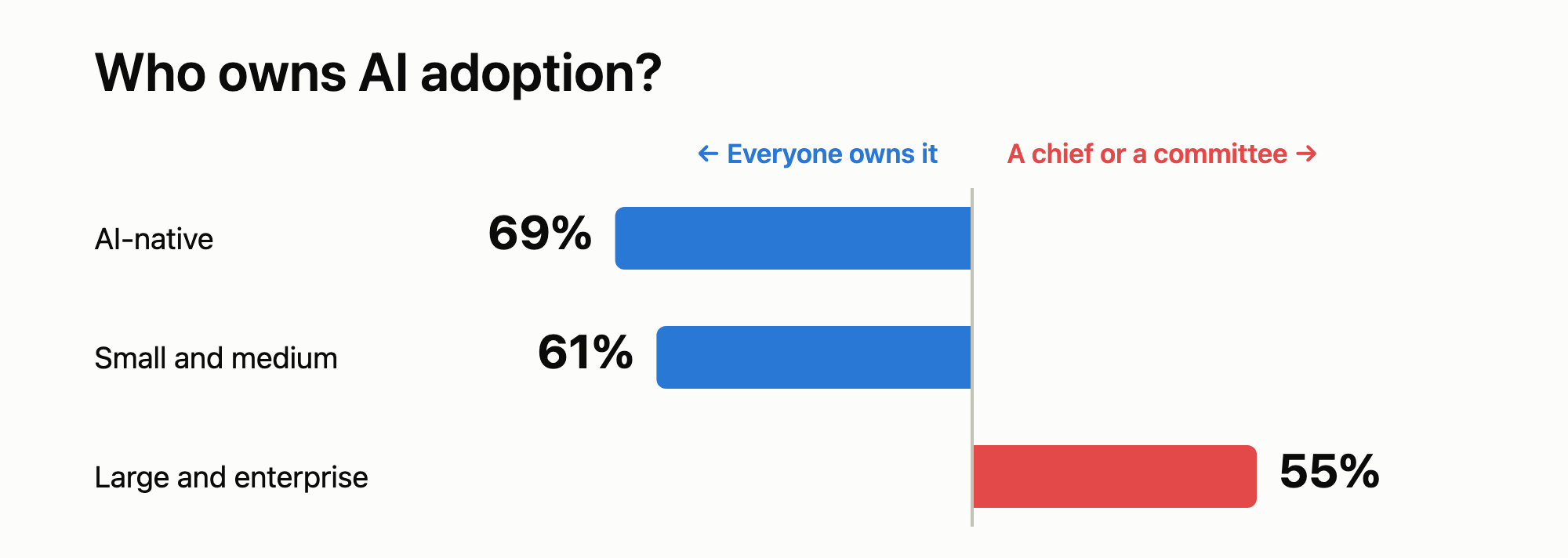
The AI-native segment overwhelmingly embraced the bottom-up strategy. Half of them declared that every single employee is responsible for AI innovation. It is treated like foundational infrastructure, and another 19% had no formally assigned responsibility. You wouldn’t designate a single person to be ‘in charge of the internet’ or electricity!
Who measures ROI, and how?
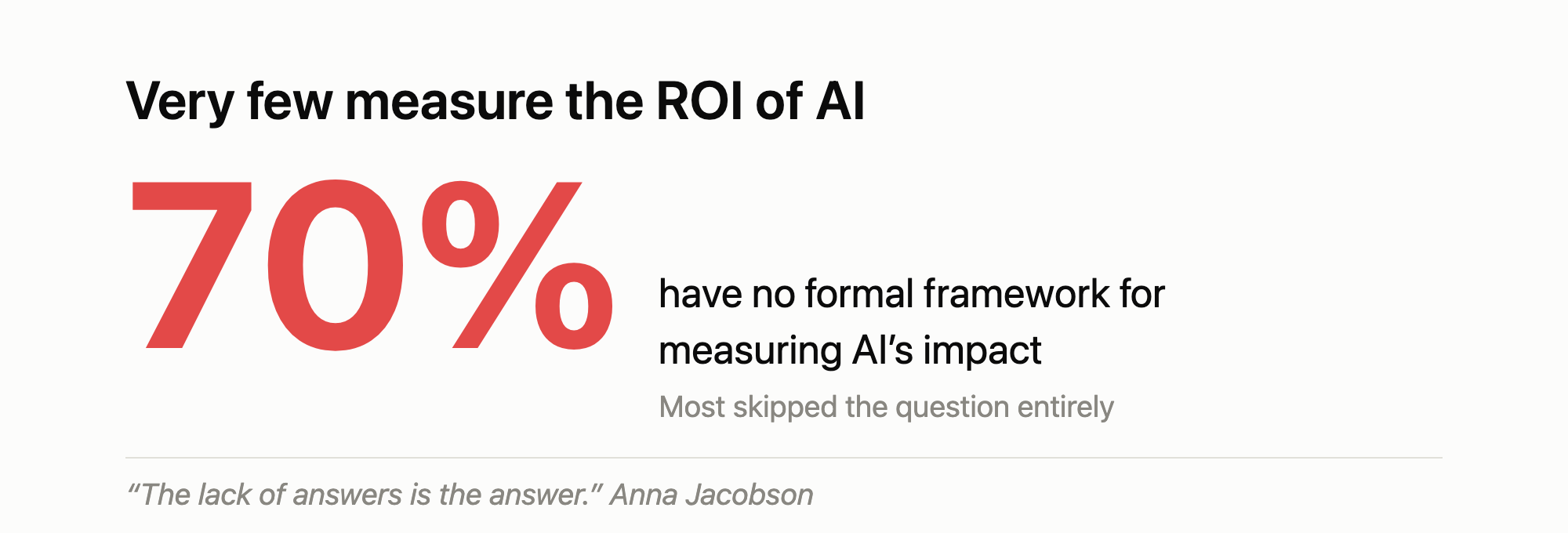
Anna Jacobson: That was one of our most fascinating findings. The vast majority of respondents skipped the ROI question entirely. Of those who did respond, 40% admitted: “We do not have any formal measurement framework in place.” Combined, roughly 70% of organizations lack structured ROI metrics. The absence of an answer is, in itself, the answer.
For teams with measurement attempts, frameworks relied on subjective productivity impressions (“it feels 10% faster”) or token usage as an impact proxy. Most intriguing was the AI-native perspective:
“We don’t measure ROI on AI because we wouldn’t have a business without it.”
Aparna Sinha: Yet 66% of respondents still cited productivity and efficiency as the primary benefit.
Anna Jacobson: Yes, and 100% of CEOs selected productivity and efficiency. However, looking at secondary priorities across functions revealed sharp differences. Operations leaders highlighted skill enhancement, GTM executives targeted strategic advantages, technical teams split between skill boosts and cost savings, while finance and legal prioritized output quality.
Perceived AI benefits vary by role
- Primary benefit, universal: productivity and efficiency (66% overall, 100% of CEOs)
- Operations: skill enhancement
- Go-to-market: strategic advantages
- Technical and product: skill enhancement and cost savings
- Finance and legal: quality improvements and standardization
Aparna Sinha: It’s fascinating that legal and finance focus on quality gains, more accurate and standardized output, while engineering targets cost and skills rather than quality. You mentioned that looking at open-text responses, change management repeatedly emerged as a top concern.
Change management, risk and workforce transformation
Anna Jacobson: Whenever leaders had room for open comments, change management dominated: mindset shifts, cultural adaptation, and internal communication. Successful technical implementation is deeply tied to organizational culture.
Risk tolerance was another key topic. Leaders felt caught between two extremes: stagnating by moving too slowly, or exposing the company to operational risk by opening up systems without guardrails. Ultimately, cultural skepticism remains a bigger hurdle than capability gaps.
Aparna Sinha: What about workforce planning? Media headlines highlight AI layoffs, but what are executives seeing on the ground?
Anna Jacobson: The vast majority reported low to medium headcount impact, 90% of medium companies and 95% of large enterprises. They aren’t predicting massive workforce reductions. Instead, the real transformation is happening in talent profiles, reshaping job roles, skill requirements, and expectations.
Which AI tools are AI-native companies using?
Aparna Sinha: Your stack data showed near 100% adoption for general chatbots like ChatGPT and Claude, plus high usage for AI meeting assistants. But for specialized tools in engineering, legal and HR, company-wide adoption vastly outpaces executive usage. Are executive roles insulated from AI transformation?
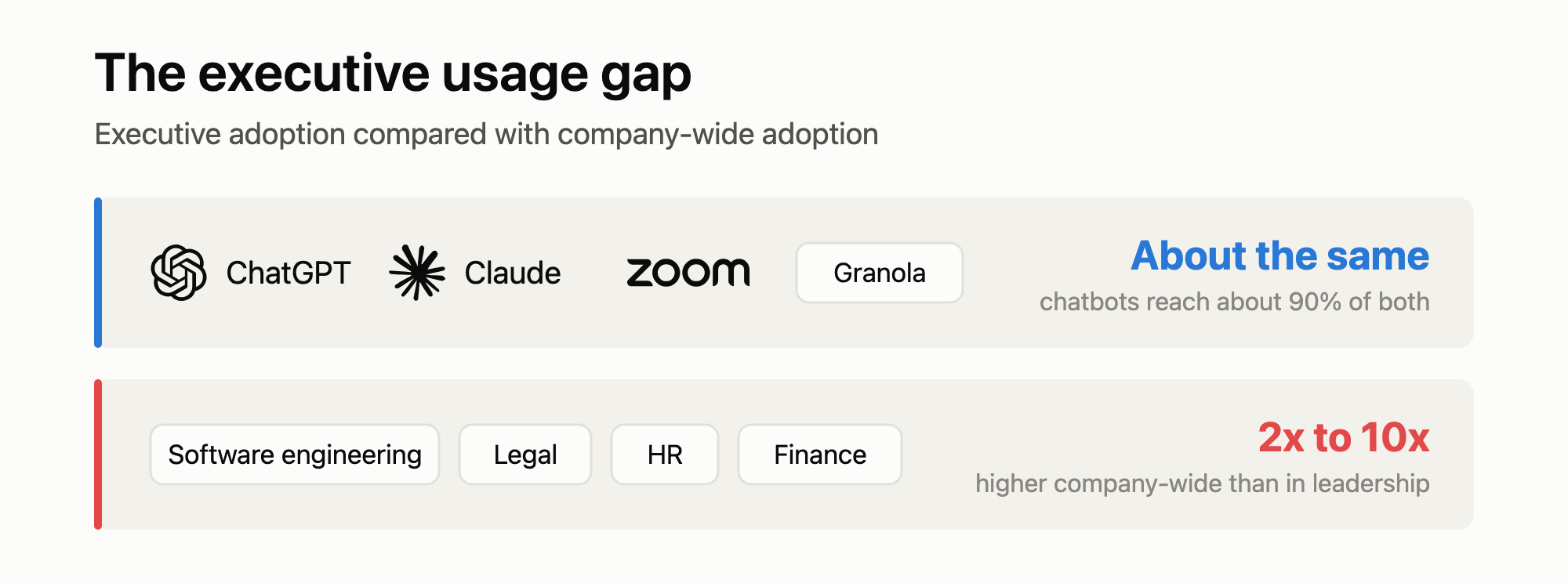
Anna Jacobson: The impact on executives differs from frontline operators. Regarding insulation, everyone asks: “Is AI coming for my job?”
“My take: experienced strategic judgment is something AI cannot replicate. Much of today’s ‘AI slop’ consists of output that sounds senior-level on the surface, but lacks authentic executive judgment.”
Aparna Sinha: While tool landscapes change rapidly, the forward-looking trends you captured are extremely telling.
Anna Jacobson: While current tool usage is highly concentrated, planned experimentation over the next 12 months is widespread. Two major themes emerged: data defragmentation, stitching disparate data sources into a unified AI ecosystem, and true autonomous execution, moving beyond basic workflow automation to genuine agentic autonomy.
Aparna Sinha: Data defragmentation is a massive strategic insight. Thank you for walking through this data with us, Anna.
Anna Jacobson: It was a pleasure! These insights help us shape the questions for our next annual survey.
The State of AI Transformation 2026 was published by Operator Collective in February 2026, with data gathered from November 2025 through January 2026. You can read the full report here. Axios covered the findings the day the report came out. With thanks to Anna Jacobson for the conversation and for sharing the underlying data.
Related Articles
Who Owns the Legal AI Harness?
Baker McKenzie & Legora on Build vs. Buy, Pricing, and the future of Legal AI
Read articleHow Coursera Became an AI-Native Enterprise
Coursera is a fourteen-year-old public company that transformed itself to the leading edge of AI. CTO Mustafa Furniturewala and Mint MCP founder Jiquan Ngiam break down how an established enterprise becomes AI-native: enablement, culture, and automation.
Read article